CLIMATE CHANGE
Dark winds are blowing through Ukraine and storm clouds are gathering

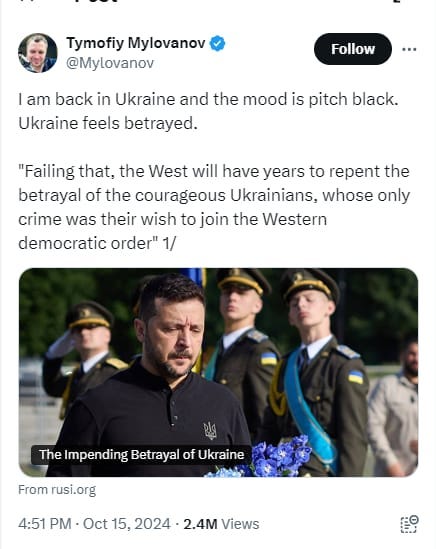
No sooner had the Russians invaded Ukraine in February 2022, than the pundits, prognosticators and propagandists on both sides went into action, confidently predicting that the Russian army would quickly be repulsed and sent packing, leading to the swift and ignoble downfall of Vladimir Putin and, for the other side, that Ukraine would quickly be overwhelmed and the Russian tricolour would be fluttering over Kiev before you could say ‘glasnost’.
Neither of those things happened. Instead of WWII-style blitzkrieg, the conflict settled down into WWI-style attrition, with all the static trench warfare horrors that go with it. Still, the Western press and governments were unswerving in the publicly and frequently stated belief that Russia was losing and Ukraine was winning and that it was only a matter of time before Volodymyr Zelenskyy led his victorious army into Moscow, thereby achieving what both Napoleon and Hitler failed to accomplish. They pointed to the seeming inability of the Russians to advance beyond these lines of conflict in the Donbas region as evidence that the Russians were incompetent, poorly equipped and even more poorly led. Thus, the final Ukrainian victory was all but inevitable.
What they failed to understand or, perhaps did understand but were reluctant to acknowledge, was that the Russians were not seeking territorial conquest but, rather, a relentless grinding down of Ukraine’s ability to fight and NATO’s ability to re-equip them for that fight. In this, it appears, they have been successful, because now the terrible truth is starting to emerge in the Western press.
Of all the organs of the Western press (all of which are tightly controlled), the Financial Times has been the loudest and proudest cheerleader of the ‘Ukraine is winning’ narrative. So, there is significance in this admission, published only this past week, that faces up to dark reality:
Ukraine is heading into what may be its darkest moment of the war so far. It is losing on the battlefield in the east of the country, with Russian forces advancing relentlessly — albeit at immense cost in men and equipment.
It is struggling to restore its depleted ranks with motivated and well-trained soldiers while an arbitrary military mobilisation system is causing real social tension. It is also facing a bleak winter of severe power and potentially heating outages.
“Society is exhausted,” says Oleksandr Merezhko, chair of the foreign affairs committee of the Ukrainian parliament.
At the same time, Ukrainian President Volodymyr Zelenskyy is under growing pressure from western partners to find a path towards a negotiated settlement, even if there is scepticism about Russia’s willingness to enter talks any time soon and concern that Ukraine’s position is too weak to secure a fair deal right now.
The FT article is behind a pay wall, but you can download a screenshot of it here.
This is not the only ominous portent that has occurred in this week. The German government also announced a halt to the transfer of any more heavy armour to Ukraine and this announcement, too, was a foreshadow of what was to come later.
Zelenskyy has consistently refused to even entertain the notion of negotiating terms with Putin. But it wasn’t always this way. Back in April 2022, representatives of both parties were hammering out a deal in Istanbul. It was all done bar the shouting; champagne corks were being popped in celebration, according to the guy who was there, Oleksiy Arestovych
FS: Do you think that bilateral negotiations between Ukraine and Russia could have worked earlier in the process? There has been a lot of discussion around those early months, when there were negotiations in Istanbul.
OA: Yeah, I was a member of the Istanbul process, and it was the most profitable agreement we could have done. They concluded there two previous agreements that were extremely dangerous for Ukraine: Minsk one and Minsk two. This agreement even contained the question of Crimea. It took 10 years of discussion, 15 years of discussion on the status of Crimea, and it meant security for the Black Sea. But now — I don’t know. Because mid-agreement in Istanbul we came to Kiev and after Bucha we heard from the President that we had stopped the negotiations. The next meeting was to be on the ninth of April and on the second of April it was declined.
FS: So you came back from Istanbul thinking the negotiations had been successful?
OA: Yes, completely. We opened the champagne bottle. We had discussed demilitarisation, denazification, issues concerning the Russian language, Russian church and much else. And that month, it was the question of the amount of Ukrainian armed forces in peacetime and President Zelenskyy said, “I could decide this question indirectly with Mr. Putin”. The Istanbul agreements were a protocol of intentions and was 90% prepared for directly meeting with Putin. That was to be the next step of negotiations.
The negotiations were killed in early April by Zelenskyy himself, following a visit to Kiev by then British Prime Minister, Boris Johnson. Nobody, apart from Johnson himself and Zelenskyy, knows what they discussed but there is plenty of speculation that, for Washington (on whose behalf he was speaking), deals with Russia were unacceptable. The only way forward was military victory for Ukraine. Perhaps Johnson threatened Zelenskyy, or perhaps made him lavish promises that the West would back all the way to marching into Moscow, and Zelenskyy fell for them.
Others claim that the infamous ‘Bucha massacre’ was the turning point. The Ukrainians blamed this on the Russians, and the Russians blamed the Ukrainian hard-liners. For sure, it was carried out by someone who did not want those Istanbul negotiations to succeed. So, the champagne was put back on ice, or perhaps poured down the sink, and the war ground on.
A much-publicised Ukrainian counter-offensive, first planned for the Spring of 2023 and then delayed until the summer, was supposed to carve a path through the Russian lines, push all the way to the coast of the Azov Sea and then turn West to liberate Crimea. NATO leaders even arranged a coincidental special meeting in Vilnius, Lithuania, planned as a celebration of what they anticipated was going to be a glorious Ukrainian victory and a vindication of the Western insistence that military victory, and only military victory, was acceptable. That was Plan A. Plan B? There was no Plan B. They even went as far as to promise to hold ‘Crimean back parties’ once that land had been wrested from Russian control.
The outcome was a bloody, costly and embarrassing disaster. Despite the undeniable bravery and tenacity of the Ukrainian forces, they were repelled without managing to push the Russians back by even an inch or scratch the paintwork on their defensive lines. It was reported that the failed counter-offensive cost Ukraine around 30,000 men.
Still, there was no Plan B. Negotiations were unthinkable because a negotiated settlement would inevitably reward Putin with something, and that couldn’t be allowed. So, the conflict trundled on, with the death and casualty toll mounting on both sides.
Then in August of this year, the Ukrainians actually sent an invasion force into Russia, specifically the relatively unguarded Kursk oblast. They actually caught the Russians with their pants down and managed to advance quite deeply into the region before the Russians got their act together and started to push them back. Now, as at the time of publication, this Ukrainian invasion force has run out of steam and supplies. There are reports that the remaining Ukraine forces are being ‘pinched into a pocket’ and, if that is true, then it is only a matter of time before they are captured or eliminated.
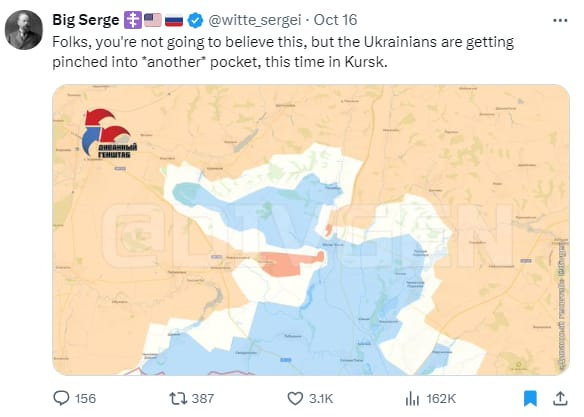
The Kursk incursion was never going to succeed or bring any advantage. It was a PR exercise, a morale booster; something to generate gloating social media posts but which was never going to succeed in achieving more than that. Lord only knows how many more Ukrainian lives have been sacrificed for nothing.
The Kursk incursion, it seems, may prove to be a ‘last hurrah’ for Kiev, only there is no ‘hurrah’ to speak of.
On October 16th, Volodymyr Zelenskyy addressed the Ukrainian parliament. His address is divided into a public part and a secret part. The public part, which Zelenskyy has dubbed a 5-step ‘Victory Plan’, does contain a qualified admission that he desires to bring Russia to negotiations:
1. Immediate NATO Membership for Ukraine.
2. Continued Military Operations: Ukraine's military strategy focuses on maintaining pressure on Russian forces.
3. Non-Nuclear Deterrence: A new deterrence package is in the works, designed to offer powerful defensive measures and bring Russia to negotiate.
4. Economic Strength and Peace: Zelenskyy unveiled a comprehensive economic plan involving partnerships with the EU and the US.
5. Veteran NATO Force: The plan envisions Ukraine's experienced military becoming a crucial defense force within Europe, potentially leading regional security efforts alongside NATO.

Zelensky presents 'victory plan' to Ukrainian parliament | BBC News
So, it seems that there is now a Plan B, although any enthusiasm must be tempered by the fact that, as yet, nobody outside the Ukrainian parliament knows what was contained in the secret part of the address. But it is still significant; a begrudging admission that Ukraine cannot defeat Russia militarily and, at some point – maybe some point soon – the bloodshed must come to an end.
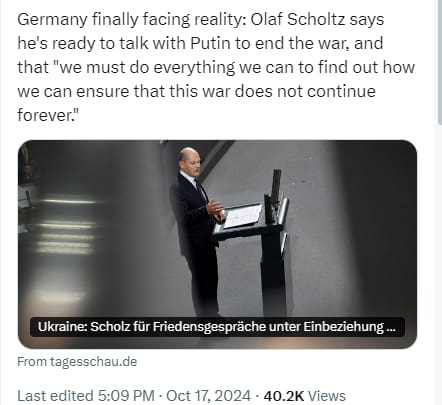
Outside of Ukraine, the German government followed up its denial of further heavy armour transfers to Ukraine with a call from Chancellor Olaf Scholz to commence talks with Russia – a call which was unthinkable even a month ago.
So, why is the mood in Ukraine ‘pitch black’? Surely, the end of war should be a cause for joy? Normally, yes, but perhaps everyone senses that they have sacrificed so many of their young men (with some sources claiming a figure of more than half a million) only to end up with less than they would have had, had the Istanbul negotiations been allowed to come to fruition.
Having sacrificed so much themselves, the Russians will be in no mood to grant concessions or relinquish even one square metre of the territory they have conquered and now declared to be a part of Russia. From Putin’s point of view, why should they? They’re winning.
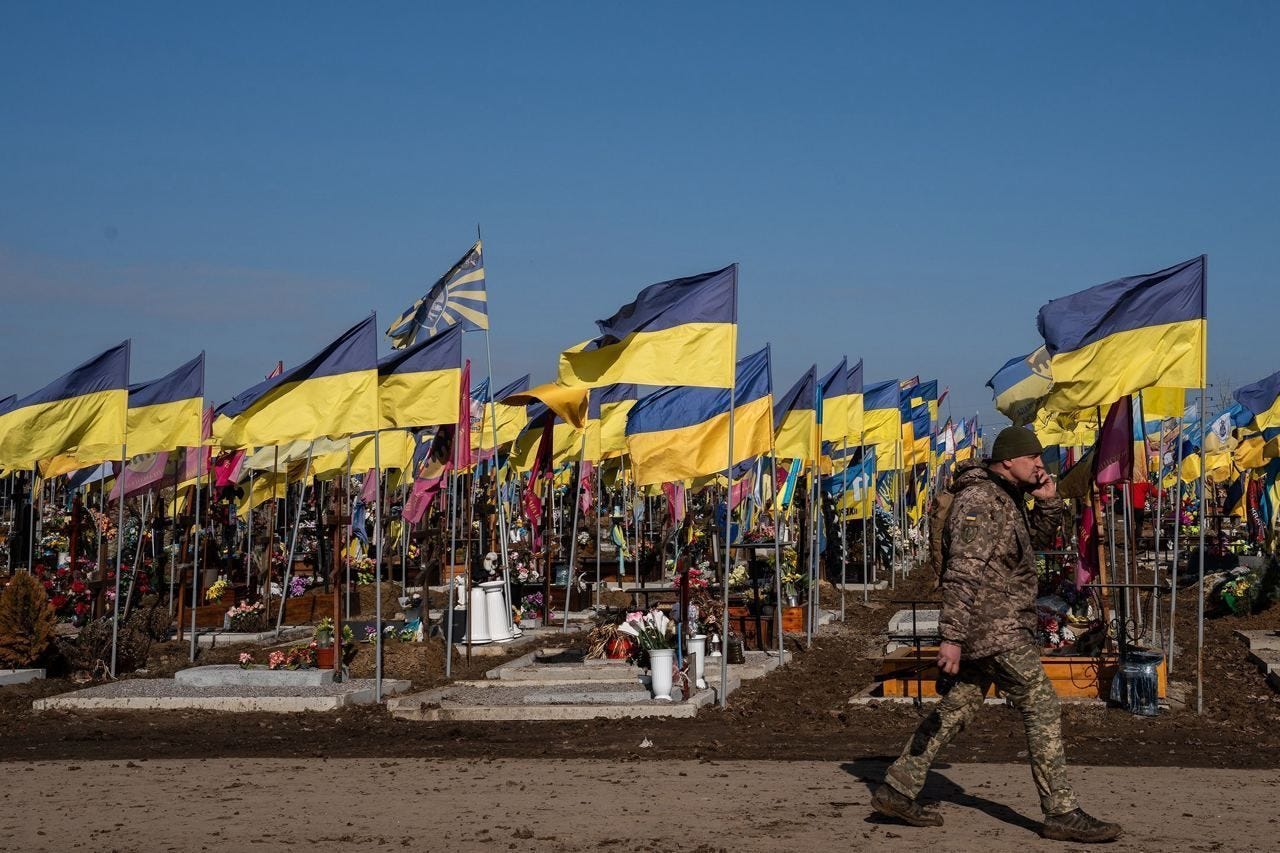
Ukraine is now carpeted with cemeteries full of the remains of over a half a million of their men, a scattered diaspora which is unlikely to return, and a beggar economy which is dependent upon them selling off any remaining assets they have just to stay afloat. No wonder they feel betrayed.
Even once a deal has been struck, assuming it can be, the bitterness will remain; it will remain and fester until the ghosts of the multitudes of dead burst forth out of their graves, shrieking for vengeance.